I know it's been a few weeks since I've updated my blog. And that's primarily because my computer is full and I need to delete stuff before I can upload more pictures. If you know me, that's a time consuming endeavor having to choose what to delete and hoping that my external hard drive doesn't give out on me.
All technical difficulties aside, I decided to write about the similarities and differences between the public education system in the United States and in Spain. Granted, the information I have gathered about both is from limited experience and from what other teachers have told me.
The following are the similarities:
1. Budget cuts. Yes, teachers in Spain complain about the budget cuts and the revamping of the education system. However, the school I work at in Alcobendas is in a wealthy suburb of Madrid. Every classroom has a computer, printer, smartboard, as well as enough desks, chairs, and textbooks. The school requires students to take music and art class and offers afterschool activities including dance and sports.
2. More paperwork. Two weeks ago all the teachers were stressed out because someone was coming to observe the school and required the teachers to turn in their syllabus for the year. I explained that in the United States, teachers complain about the ever increasing paper work and feel more like secretaries than teachers.
3. Less time to be creative. And in turn, teachers have less time to be creative with their lessons. The more time spent trying to follow standards and scientifically prove student progress, the less effective a teacher becomes. Teaching is inherently creative and that art form is being squashed here too.
4. Disparity. As in the States, the quality of education here in Spain depends upon living in the right neighborhood.
The following are the differences:
1. Religion class. In Spain, every public elementary to high school requires students to take a religion class. The class focuses on the history and beliefs of Catholicism. Obviously this is a huge difference between public schools in the States, where teachers are not allowed to initiate conversations about religion.
2. Students or teachers change classrooms. In a bilingual elementary school, the students or teachers change classrooms. At my school, the students change classrooms. The purpose is for students to associate one classroom with speaking English and the other classroom with speaking Spanish. In the States, students typically begin switching classrooms when they are in middle school or junior high, except for some charter school which have students change classrooms when they are in elementary school.
3. No National Standards. Teachers are only required to follow the curriculum in the textbook! But bilingual schools are required to prepare students for the Trinity exam, a test comprised of a prepared writing sample about a chosen topic and conversation. The school pays for each student to take the exam and the school is rated based on how well their students do on this exam.
4. Breakfast & Lunch Break. Teachers at my school have a thirty minute break to have coffee, fruit, donuts, or toast while the kids eat their snack and play outside. And then we have an hour break to eat lunch together. In the States (at least from my experience) teachers only have time to sit in their classroom and eat lunch while grading papers, attending a meeting, or preparing for the next class.
5. Special Education. Students with special needs do not have a separate class but are included in the general classroom. In Spain, students with special needs simply receive differentiated instruction from a general education teacher. The teacher is not required to have a license in special education.
6. Tenure. There is only one tenured teacher at the school I work at. The process of becoming a tenured teacher is more difficult here than it is in the States (even with the changes made by Bloomberg in NY). You are required to take tests as well as be observed by the principal, be interviewed, and have a portfolio.
7. Halloween. We get to celebrate Halloween at school! The teachers and sixth graders are making a haunted house for the students which includes ghosts, a seamstress sewing a dead person, a typist writing You're going to die on the typewriter (that's me), zombies in chains, fake blood, fingers, and eyeballs. Eva, the teacher organizing all of this, said to be sure to scare the students from behind so they don't knock each other over. She suggested I growl or hiss at the students as they pass by me. Needless to say, I'm preparing myself for total chaos.
The general sentiment I've gotten is that with each new district president, major changes are implemented to the education system. And when there is little improvement, there are more changes. I've talked to several Spaniards (my roommates Marcos & Armando, plus Julian, a student I'm tutoring) about how dissatisfied I am with the language instruction I received in elementary and high school. That I don't remember anything because I never practiced or had to use it. Even though they speak English much better than I speak Spanish, they say they feel the same way and that in Spain people only speak Spanish. They tell me the only reason they know more English than I know Spanish is because they listen to music and watch tv shows and movies in English.
That's all I've got for now. Hopefully my next post will be full of pictures from what I've been doing in Madrid the past few weeks!
Saturday, October 26, 2013

Tuesday, October 15, 2013
Weekend Trip to Jerez de la Frontera
There are things about Madrid that are similar to New York. One is my morning commute. The train I take at 8:30 to Alcobendas is crowded, mostly with college aged students. Rarely do I find a seat until the train is almost to my stop. But the main difference is the train is above ground. So for forty minutes I have a lovely view of fields with grazing horses and the mountains in the distance.

After work on Friday, I took a train to Jerez de la Frontera to celebrate Anna's birthday. I met Anna in Sevilla and we were in the same Spanish class at CLIC. Jerez is famous for its sherry, so of course we took a tour of Bodega Tio Pepe. This was my first wine tasting/tour, and I thoroughly enjoyed it.


This is where the wine tasting happened. I liked the dry sherry but absolutely hated the sweet sherry.

Here's the group of English teachers I went to Jerez with. From right to left: me, Stephanie, Laura (who lives in Jerez and is from NY!), Jenny, Anna (birthday girl!), Caroline, and Anton (I tried to remove the red eye but it didn't work!)

Tio Pepe has a tradition of setting up a ladder and a glass of wine for the mice to drink. Pretty cute.

For dinner, we ended up at Guadalajara, a Mexican restaurant.

We had cava, cake, and ice cream. Anton and Anna also tried some of the lime looking oranges (looks like a lime, tastes like an orange) from one of the trees along the streets of Jerez.

We also played Quien es Quien (Guess Who). Board games were provided by BB Jerez where we stayed.

Jerez is small, about 200,000 people. It was nice to visit for the weekend and be able to walk around without getting lost. All of the pictures in this blog post were provided by Jenny, Stephanie, and Laura.
On another note, I've been listening to Cheyenne's new album Kings County. Thanks for making me miss Brooklyn hardcore.
Sunday, October 6, 2013
Vive despacio

I found this friendly little reminder in my closet to live slowly. And I definitely need to be reminded of that on a daily basis. Friends who have lived in Spain warned me that the way of live here is much slower, especially coming from New York. A few examples of the slow paced, relaxed lifestyle are that cars always stop for pedestrians, ALWAYS! Wherever there is a cross walk with no walk signal, you have the right of way. Another example is my roommate Armando. Several times I have asked him a question about what bank he recommends (Barclays), or how to get to IKEA (take the 1 train to Las Suertas), and even though he is on his way out the door to visit his abuela or run errands, he stops to help me. If I were in his shoes, I would be thinking, I'm on my way out the door and I have things to do so I'll tell you later. There isn't the same sense of urgency here, and I feel that on my walk to Atocha every morning on my way to work. Like New York, it's easy to feel like all these people, walking/living slowly, are just in my way.
Now I'm going to backtrack a bit, because I forgot to mention this in my last post. When I was in Sevilla, my favorite food that Maro (my host mom) made was tomato salad. It's so easy to make and it's cheap! All you need is bread, tomatoes, onion, olive oil, white wine vinegar, and a pinch of salt. Try it!

A week ago I ventured to IKEA with my friend Michelle. And thank goodness Michelle went with me because it was my first time to IKEA! That's right, I lived in New York for eight years without ever going to IKEA. And I purchased a nightstand (which I assembled all my myself), a lamp, sheets, a pillow, a candle, and measuring cups (it's the only thing the kitchen was lacking).

Then we strolled through Retiro Park which is a ten minute walk from my apartment. It's the Central Park of Madrid. The only difference is that dogs run free! That might be another one of my favorite things about Spain. Dogs are rarely on a leash, especially at the park, and are allowed inside bars.

Here is Atocha Station which is about five minutes away from my apartment.

My roommates treated me and Michelle (she stayed with me until Tuesday when she moved into her apartment) to chocolate con churros. Needless to say I didn't eat much for dinner that night.

I'm pretty sure I ate four or five churros? And helped Michelle finish her chocolate. Surprisingly, I haven't gained weight.....yet.

This was my first week at CEIP Antonio Machado. And I already have 3 tutoring lessons set up after school! I mostly helped with English evaluations this past week and assessed students conversational English. The 4th graders will take the Trinity exam in the spring, and it is essentially my job to prepare them for it. Every bilingual school pays to take this test to receive a certificate stating that their students are proficient in English. It's a big deal, like standardized tests in the United States. The test consists of two parts, conversation and a writing sample on a chosen topic. In science, the fourth grade is studying the digestive system and the 5th graders about living and non living things. I'll be doing some research on those topics this weekend, considering I haven't had science since high school!


This weekend I went to El Tigre for dinner. It's always crowded with international students because you can order a beer for 2.50 euros and get a huge plate of tapas with it. Then I went to Tupperware (pictured below), a bar in Malasana that was recommended by friends and my Spain Lonely Planet Guide. I think it lived up to the hype and if you visit me, I'll probably take you there.

Even though I didn't like the other bar we went to in Malsana, this FNL poster made me so happy. However, I was disappointed that my friends Denise and Nangi had no idea what tv show I was talking about.

Today I went to church at Iglesia Espanola Reformada Episcopal and then met up with friends at El Rastro, a huge flea market that takes over the streets of Madrid every Sunday.

And now I'm on my way to Museo del Prado! Hasta luego.
Saturday, September 28, 2013
Moving on up to Madrid
Here are a few highlights from my last week in Sevilla. Antonio, my Spanish teacher at CLIC, took us to a film museum with exhibits of Goya award winning films (Spain's version of the Oscars). I was pleasantly surprised to see Jeff Goldblum's picture, because he starred in the Spanish film El Sueno del Mono Loco. Here I am with Madelyn, one of my classmates.


I enjoyed living in Sevilla for a month, and highly recommend traveling there if you're in Spain.

I also highly recommend Dulce Regina. The coffee and cookies are delicious (but not as good as Katie Walker's of course). And it's a good deal, only 2 euros! I probably went there every other day on my way to school and will miss it now that I'm in Madrid.

I arrived in Madrid on Sunday and stayed at Hotel Husa Princesa until yesterday. The hotel was lovely, but didn't include wifi which is why I'm a bit behind on blogging. (They were asking for 9 euros a day!) I explored the city a little bit, walking from my apartment near Atocha Station to the hotel in Princesa. Here is the Bank of Spain, which is about 25 minute walk from my apartment.

This is Grand Via, one of the main streets in Madrid. My roommate Armando told me it was designed to look like the architecture of New York. I told him the buildings were too white, clean, and short for New York.


After getting the keys to my apartment, my first priority was getting my bed set up. The room already had a mirror, shelves, a desk, chair, and much more closet space than my room in New York. Score!

I took a picture using the app Photosynth, and this is what I ended up with.

This is the view from my window to the right. It's been raining on and off all day, but I don't mind because it finally brought fall weather to Madrid!


And out my window to the left

Yesterday I went to Atocha Station to take the Cercanias train to Alcobendas where the school I will be teaching at is located. It's about a 45 minute commute.
And there's a green house inside Atocha with cute little turtles.

I met the two other language assistants at my school, Denise from Australia and Justin from California. I met the language coordinator, the principal, and most of the teachers at CEIP Antonio Machado. Everyone was very kind, warm, and welcoming to us. Justin worked as a language assistant at this school last year, so I will be going to him with all my questions. There are about 400 students ages 3-12. I will be working Tuesday-Friday from 9:30 - 4:30 with a 30 minute break for breakfast at 11:30 and a 2 hour break for lunch from 1 - 3. I will be teaching 4th and 5th graders science and english.
Yesterday, all the teachers went out to lunch together in Tres Cantos, where Tasio (the P.E. teacher) lives and his father owns a restaurant. We spent 3 hours eating, drinking, and speaking in Spanglish. The teachers are as eager to practice their English as I am to practice my Spanish. The principal asked if I could tutor her children after school once a week and that she would tell her friends to contact me if they're interested!


There's always so many more pictures I could post and stories to tell, but I'm trying to hone my editing skills. However, I will say that this week I missed New York a lot because my best friends (Seth and Dana!!) from Oklahoma are visiting. Send BK my love. XO
Tuesday, September 17, 2013
a child who never grows up
This weekend I went to Morocco with Discover Excursions. We took a bus from Sevilla to Tarifa, a town on the coast of the Straight of Gibraltar. Then traveled by ferry to Tangier (I managed not to get too sea sick), got back on the bus until we arrived at our hotel in Tetuan.


Saturday morning we traveled to Chefchaouen which is about an hour away from Tetuan. Since I've traveled more in the past few months than ever before in my life, I've been researching famous writers or poets from the places I visit. Abdellatif Laabi is a Moroccan poet who was imprisoned for ten years and then exiled to France for his political beliefs and writings. Here is one of his poems...

I'm a child of this dreary century
a child who never grew up
Doubts that set my tongue on fire
burned my wings
I learned to walk
then I unlearned it
I grew weary of oases
and camels eager for ruins
My head turned to the East
I lie in the middle of the road
and wait for the caravan of the mad
We spent the day in Chefchaouen with a tour guide who told us about the rich and complex history of the people of Chefchaouen. We walked around the Medina, which is the oldest part of the town. All the buildings are blue and white for two reasons: first because the blue signifies Allah and white signifies peace, and secondly because these colors keep the buildings cool and mosquito free.

I found a bit of NYC/Milton Glaser's influence in Chefchaouen.


There were cats everywhere! And I mean everywhere.


We sampled some of his bread.


What amazed me about Chefchaouen is that such beauty comes from simply painting all the buildings a particular color.


We went shopping which was an exhausting endeavor. Everyone wants you to buy something and will barter with you until blue in the face.

My only purchase was a henna tattoo, and yes I bartered for it.

This is the view from my hotel room in Tetuan.

On Sunday we went to Asilah. Here I am with Julia and Laura.

We went to a market inside a cave.


And then we rode camels. I was in the last group to ride the camels and had a moral dilemma because the camels, especially the first one, were not happy.


The remaining pictures are in the medina of Asilah. There were many murals, art galleries, and an amazing view of the beach!


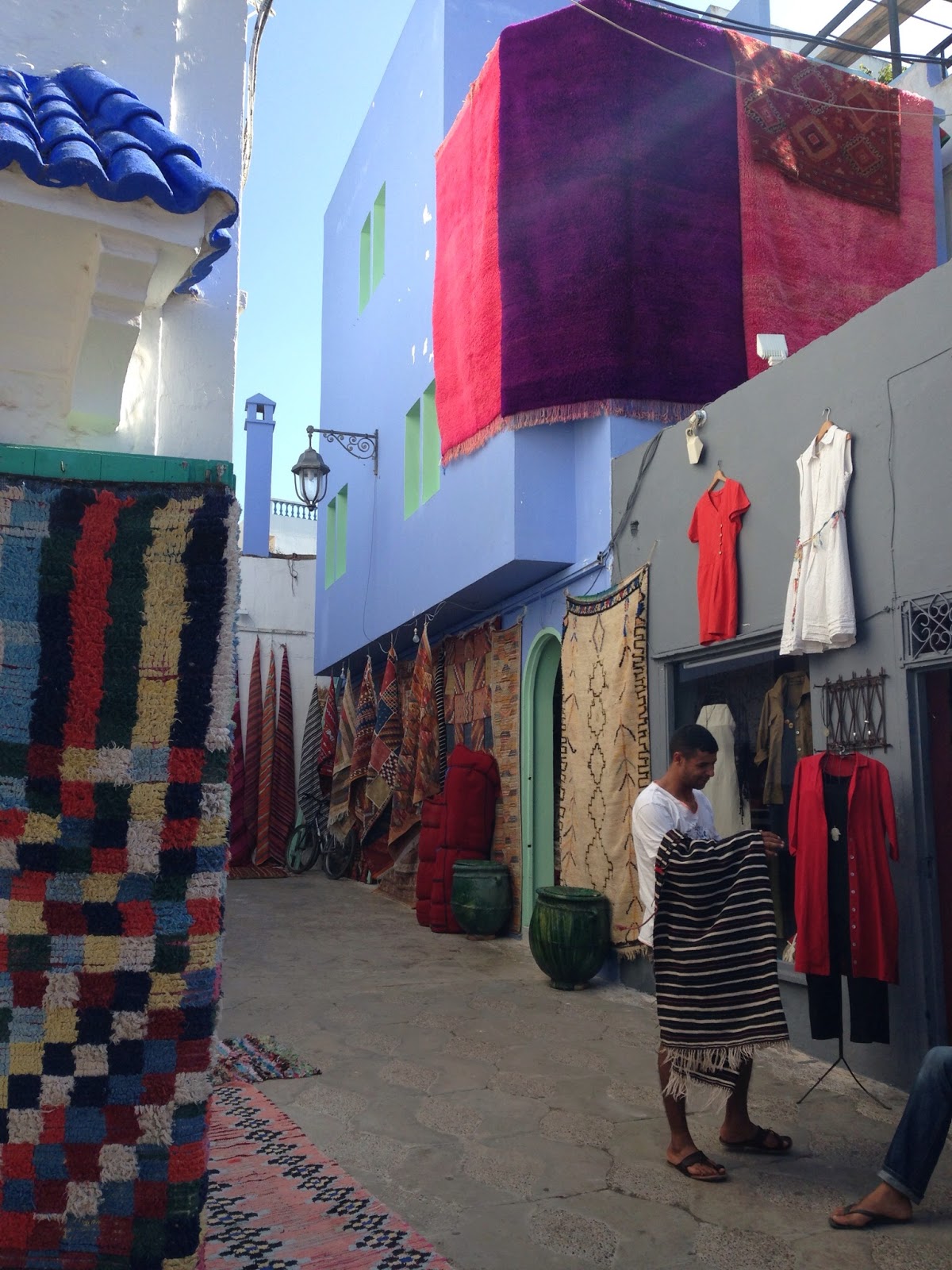
When we left Asliah to return to Tangier for the ferry, we were warned that sometimes children will try to get on the bus to make it through customs and into Spain. Sure enough, there were kids riding outside on the back of the bus. Later we were told that two kids were hiding underneath the bus before we got on the ferry, and one more kid made it to Tarifa hiding under the bus but was found by the police and sent back to Morocco.


Morocco is an interesting place because it is heavily influenced by Spanish and French culture. The people there speak Arabic, French, Spanish, and English! And you can watch television in any of those languages.
Subscribe to:
Posts (Atom)